
How abstract words can block your strategy
Or a plea to stop using fuzzy words like "value add"


The amazing thing about abstract art is that each person can walk away from it with a different reaction.
That is the opposite response we want for our strategy. A key element of great strategies is that they are concrete. This will make your idea clear.
Take Airbnb’s strategy, for example: create a site where people who want to make money from their extra bedroom can connect with travelers who want an affordable, relaxed place to stay.
Weak strategies, like improving customer experience, are abstract. They aren’t definite. What part of the experience needs improvement? What does improvement specifically mean?
These high-level statements are common in the business world.
Take, for example, this slide from Expedia’s presentation at Deutsche Bank’s 2024 Technology Conference:
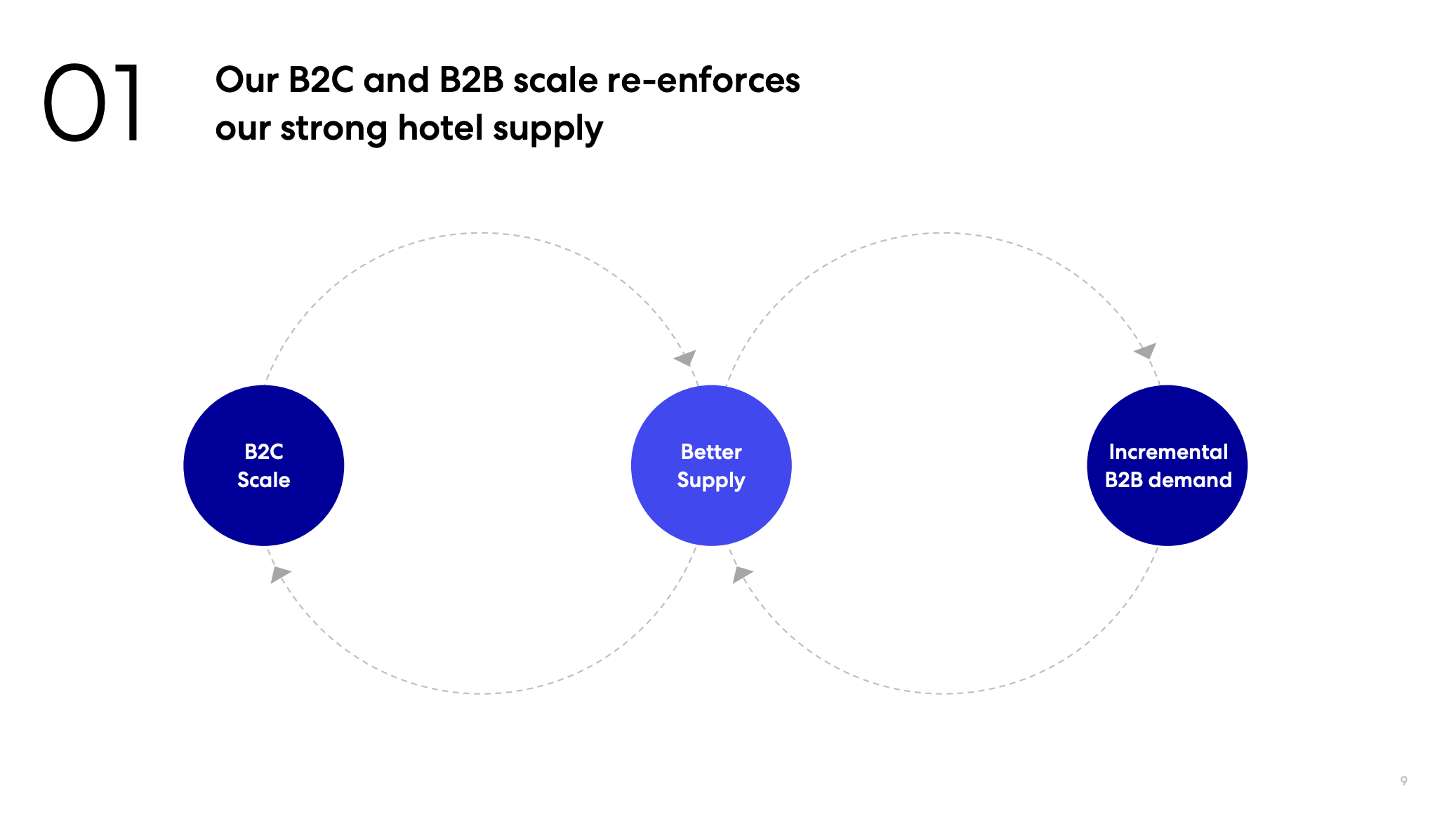
We can understand the message (how their scale reinforces each side), but not the details around the benefits of that scale (presumably better supplier negotiations or more variety for customers).
In other words, this slide focuses on the general (the abstract idea of scale) but not the particular (the concrete mechanics or benefits of such scale).
Abstract vs concrete words
You may remember learning about concrete and abstract nouns in school.
Concrete nouns are things you can touch, taste, see, and smell. Like “apple pie.”
Abstract words do not have any physical properties and are more conceptual. Like patriotism.
We see fuzzy, abstract words all of the time at work, such as:
Culture
Customer Loyalty
Disruption
Innovation
What do you see when you visualize “innovation”? Chances are that you and I would think of different things.
Concrete words like “chair” conjure up specific images in our mind when we hear them; you may think of a desk chair or a dining room chair, but it’s still a chair.
It is harder for us to imagine specifics when we hear abstract words. While we may know the exact definition of innovation, what it looks like to each of us is different.
Abstract words can thwart your strategy in two ways:
Unfocused energy: it’s harder for people to focus their energy because they don’t fully understand what you mean. If you ask someone to “leverage data” in his or her job then there are a lot of ways to do that.
Forgettable messages: studies have shown that people remember concrete words better than abstract words because of our mind’s ability to link words with specific images. If your slides are oversaturated with fuzzy language, your audience will therefore have a harder time remembering what you’re sharing.
In other words, people don’t know what you’re saying and they don’t remember what you said.
Consequently, your odds of successfully achieving your strategy have become much longer.
Here is the question you must ask: can someone picture what you’re saying? If not, provide specific facts, statistics, or examples to help your reader.
Let’s look at a slide I made that’s based on a public company’s presentation:
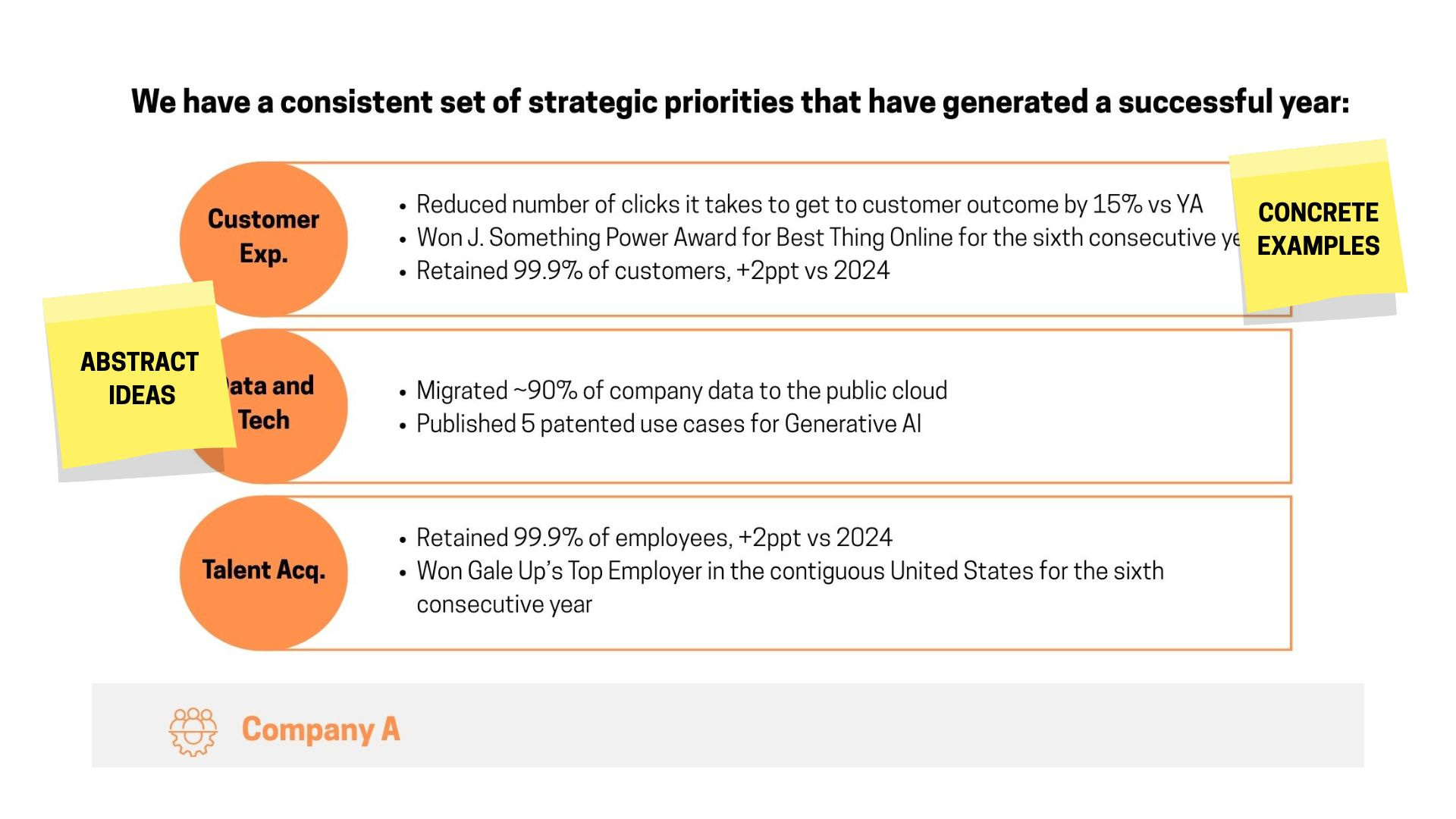
The writer outlines outline three components of their company’s strategic priorities, which are broad. On the right, the writer gives these general themes substance by providing examples.
Clicking is an everyday activity; it’s relatable. Awards are commonplace as well. Even though migrating data is not, we can see what is happening (movement from one area to another).
How do we spot abstract words in our writing and make them tangible and specific? Let’s practice by editing a slide together:
Try this exercise:
Make these abstract statements/questions more concrete:
Can you please send me your report soon?
Our results are worse than our forecast.
Our customers want an innovative mobile app.
Thanks for reading.
Stephen
What is the cringiest corporate buzzword?